 Erie County Dept of Health
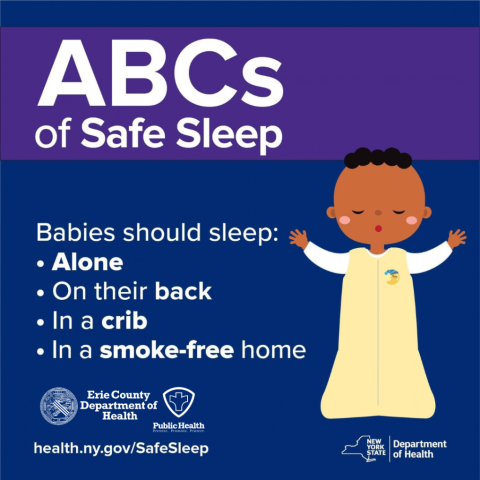
Babies sleep Alone, on their Back, in a safe Crib, in a Smoke-free home.
ERIE COUNTY, NY – Seven Western New York families have experienced the devastating loss of a newborn infant in the past two months. These deaths, investigated by the Erie County Medical Examiner’s Office, were all in infants 6 months of age and younger, with an unsafe sleeping environment as a contributing cause.
“Parents and caregivers are responsible for giving their babies a safe environment to play, grow and sleep. Having a sleeping infant in a bed or on a couch is taking a dangerous gamble with their health and life,” said Commissioner of Health Dr. Gale Burstein. “During the first year of life, infants develop neck strength and motor skills to adjust their position and coordinate movement if blankets, pillows or a person block their breathing. Until then, co-sleeping can cause suffocation and crush injuries, and tragically has led to preventable deaths of infants under 1 year of age in our community this year and in previous years.”
These recent deaths happened during relatively warm weather; a desire to keep these infants warm in cold conditions was not a factor. Now that winter is approaching, parents and caregivers should prioritize the best practices – the ABCs around safe sleep for babies:
Babies sleep Alone
On their Back
In a safe Crib
In a Smoke-free home
“Those four guiding principles represent hard lessons learned by parents, pediatricians and public health,” Dr. Burstein continued. “Parents should reinforce these recommendations with babysitters, grandparents, other children in a household, and anyone spending time with an infant. Please, share this information with people in your life who have infants or who are pregnant.”
Babies Sleep Alone
- The infant should be alone in a crib to sleep. That means no other people or children; no pillows, blankets or toys; and, no bumper pads.
- Share your room, not your bed. The American Academy of Pediatrics (AAP) recommends room-sharing for a child’s first six months; it can reduce the risk of SIDS by up to 50%. Room-sharing makes feeding and changing your baby easier.
- Use a wearable blanket or other type sleeper instead of blankets to keep your baby warm and safe.
Back to Sleep
- Always place infants on their backs to sleep (“Back to Sleep”) for all naps and at night. The child will breathe easier and can help prevent Sudden Unexpected Infant Death.
- Insist that anyone caring for your baby puts them on their back to sleep. Caregivers or grandparents may not be familiar with this “back to sleep” practice. They may prefer to place infants on their side or stomach. If you are a parent, this is your child: that means your rules are the only rules.
- Some babies can fall asleep anywhere – a car seat, stroller, infant carrier, or swing. When this happens, move the baby to a firm sleep surface – on his or her back – as soon as it is practical.
Sleep in a Safe Crib
- Use a crib that meets current safety standards. The mattress should be firm, flat and fit in the crib with no gaps. Cover the mattress with only a tight-fitting crib sheet. Portable cribs and play yard style cribs are also good choices.
- Never place your baby to sleep on top of any soft surface. This includes avoiding adult beds, sofas, chairs, waterbeds, pillows, cushions, comforters and sheepskins.
- Check to see that the bedding for your baby is safe. The AAP recommends a firm, flat sleep surface in a child-safe crib, free of soft objects or loose bedding. Infants should not be put to sleep on waterbeds, sofas, chairs or other unstable surfaces.
- No bumper pads of any kind should be used. There is no evidence that bumper pads prevent injuries, and there is a risk of strangulation or entrapment from bumper pads.
Keep Your Home Smoke-Free
- Quit smoking to reduce your baby’s risk of Sudden Unexpected Infant Death (SUID)
- No one should smoke in your home or around your baby.
Breastfeeding and Other Considerations
- According to AAP, mothers who choose to breastfeed their infant in bed should exercise caution that they do not fall asleep. This puts the infant at risk.
- Take particular care when overtired which could cause a caregiver to fall asleep while holding or breastfeeding the infant. The baby is then at risk of the caregiver rolling over on them or slipping down into the chair or bed frame. Many sleep accidents happen when tired parents fall asleep while feeding their baby.
- Do not sleep with your baby, especially if you have been using alcohol or drugs (including legal, illegal, prescription, and over-the-counter drugs). Alcohol and drug use can cause a deeper sleep and decreased awareness of the infant and the surroundings. This increases the risk of entrapment and suffocation.
- Avoid co-sleeping – sharing a sleeping area with one or more adults or siblings – which greatly increases the risk of the infant becoming entrapped in bedding or smothered during normal sleep movements. This is especially true when the person sharing the bed is obese.
More information can be found at: