 Erie County Dept of Health
Call your local health department if you or a pet has contact with a bat or other wild animal
The Erie County Department of Health (ECDOH) is alerting residents to a recent increase in reported bat encounters, and reminding the public that bats can carry rabies, a 100% fatal and 100% preventable, disease. Any potential contact between a bat and a person or pet should be treated as a possible exposure.
“Our department approved 150 people for rabies post-exposure prophylaxis (PEP) in July, which was the highest total we have ever recorded for that month,” said Commissioner of Health Dr. Gale Burstein. “Based on the calls we have received so far in August, we are in for another record-breaking month. Our public health sanitarians and epidemiologists are skilled in investigating these cases and recommending PEP when appropriate.”
Rabies PEP is also known as “rabies shots,” which are a series of vaccines given over several weeks. “If you are uninsured or underinsured, do not let that be the reason you avoid calling us,” said Dr. Burstein. “When ECDOH authorizes PEP, the exposed person can receive that treatment with costs fully covered by their health insurance or by Erie County. Erie County residents do not need to pay any money themselves for rabies PEP.”
Erie County residents with concerns about a scratch or bite from any animal, including bats, raccoons, skunks, foxes or domestic pets, can call (716) 961-6800. Bats are the most common animal found to have rabies in Erie County, but they are also the most easily caught and tested. In recent years, raccoons, skunks, woodchucks, foxes and cats have tested rabies positive.
Call your health department immediately if:
- You find a bat inside a home, especially in a bedroom or near someone who was sleeping. Take special care in households with young children, older adults and people with disabilities.
- You, someone in your household or pet has direct contact with a bat or other wildlife such as raccoons, skunks or foxes.
- You find a bat in a home and the possibility of contact cannot be ruled out.
ECDOH will help assess exposure risk and provide guidance on next steps, including testing of the animal when possible. Rabies is fatal once symptoms begin; do not wait to call (716) 961-6800.
Residents can reduce the likelihood of bat intrusions by:
- Sealing cracks and gaps around roofs, chimneys, and siding.
- Installing screens on windows and attic vents.
- Ensuring doors close tightly and repair any damaged weather stripping.
- Working with a wildlife professional to safely exclude bats if they are found roosting in a home.
If you find a bat indoors:
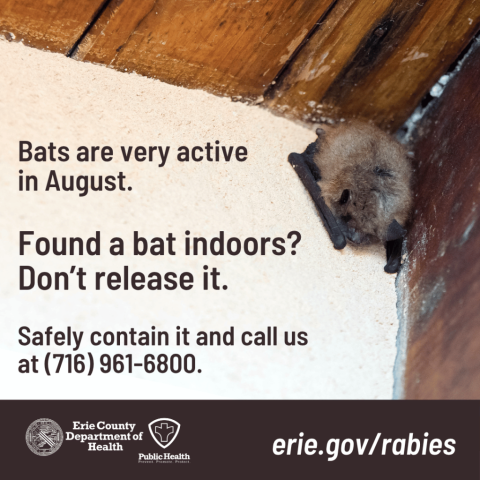
- Do not release a bat found inside until speaking with ECDOH or your local health department; testing may be required.
- Avoid touching the bat. If safe to do so, confine it to one room by closing doors.
- Contact ECDOH for guidance on safe capture or removal.
- If professional help is not available, capture the bat by gathering leather or very thick work gloves (put them on), a small box or coffee can, a piece of cardboard, and tape.
- When the bat lands, move slowly toward it.
- While wearing gloves, put the box or coffee can over the bat.
- Then, slide the cardboard under the container to trap the bat inside.
- Tape the cardboard to the container, and punch small holes in the cardboard, allowing the bat to breathe.
- Do not damage the bat’s head.
- The New York State Department of Health has a short video on how to safely capture a bat.
Households with dogs, cats and ferrets should make sure their pets are up to date on rabies vaccine and supervise pets when they go outside. “If a bat gets inside a home, it can bite or scratch your pet without you even realizing it. Rabies infection leads to an excruciatingly painful death – no one wants that for their pet,” Dr. Burstein explained. "We have two free rabies vaccine clinics scheduled this September, and others each winter and spring, for pet owners to protect their pets and household."
“We want to make sure that residents and visitors know the importance of reporting possible bat exposures quickly and starting the rabies PEP to prevent a potentially fatal disease,” said Dr. Burstein.
#