 Erie County Dept of Health
Printable version of this information (PDF, May 2025)
Prepare Your Practice
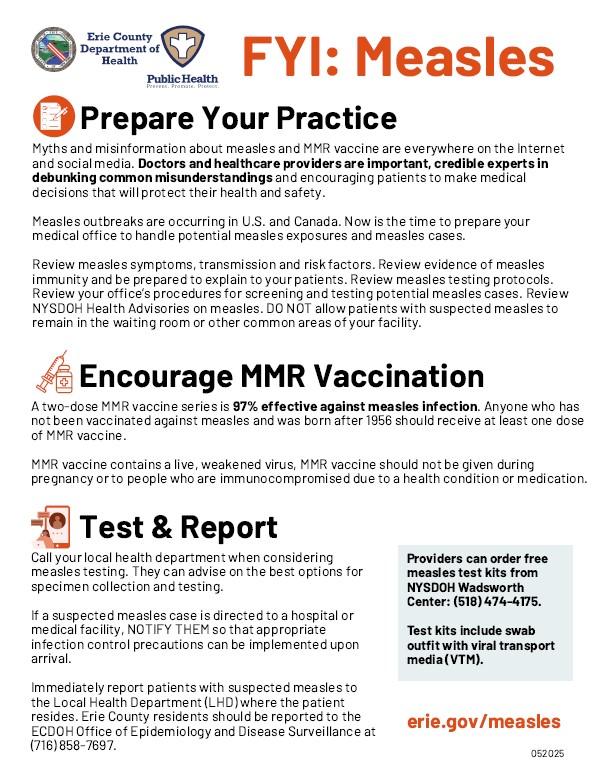
Myths and misinformation about measles and MMR vaccine are everywhere on the Internet and social media. Doctors and healthcare providers are important, credible experts in debunking common misunderstandings and encouraging patients to make medical decisions that will protect their health and safety.
Measles outbreaks are occurring in U.S. and Canada. Now is the time to prepare your medical office to handle potential measles exposures and measles cases.
- Review measles symptoms, transmission and risk factors.
- Review evidence of measles immunity and be prepared to explain to your patients.
- Review measles testing protocols.
- Review your office’s procedures for screening and testing potential measles cases.
- Review NYSDOH Health Advisories on measles.
DO NOT allow patients with suspected measles to remain in the waiting room or other common areas of your facility.
Encourage MMR Vaccination
A two-dose MMR vaccine series is 97% effective against measles infection. Anyone who has not been vaccinated against measles and was born after 1956 should receive at least one dose of MMR vaccine. MMR vaccine contains a live, weakened virus, MMR vaccine should not be given during pregnancy or to people who are immunocompromised due to a health condition or medication.
Test and Report
Call your local health department when considering measles testing. They can advise on the best options for specimen collection and testing. If a suspected measles case is directed to a hospital or medical facility, NOTIFY THEM so that appropriate infection control precautions can be implemented upon arrival. Immediately report patients with suspected measles to the Local Health Department (LHD) where the patient resides. Erie County residents should be reported to the ECDOH Office of Epidemiology and Disease Surveillance at (716) 858-7697.
Providers can order free measles test kits from NYSDOH Wadsworth Center: (518) 474-4175. Test kits include swab outfit with viral transport media (VTM).
Guidance for Suspected Measles Cases
- Healthcare providers should consider measles as a diagnosis in patients with fever (> 101˚F or 38.3˚C) and a generalized maculopapular rash with cough, coryza, or conjunctivitis especially un/under-vaccinated, e.g., children younger than 12-15 months, with a known exposure or recent travel to or from areas with known measles outbreaks.
- DO NOT allow patients with suspected measles to remain in the waiting room or other common facility areas.
- NOTIFY the emergency room if sending a suspected measles case to a hospital so that appropriate infection control precautions can be implemented upon arrival.
- Consider patients who are un/under-vaccinated for measles as priority risk.
- To promptly identify suspected measles cases and prevent exposures, consider screening patients for rash with fever at a healthcare facility’s point of entry (e.g., during appointment scheduling and at the reception desk), and inquire about recent international or domestic travel and possible exposure to measles.
- Immediately report patients with suspected measles to the Local Health Department (LHD) where the patient resides. Do not wait for laboratory confirmation to report. Erie County residents should be reported to the ECDOH Office of Epidemiology and Disease Surveillance at (716) 858-7697.
- Call the ECDOH when considering measles testing at (716) 858-7697. Testing includes the collection of either a nasopharyngeal swab (NP) or oropharyngeal (OP) swab using VTM/UTM for RT-PCR, as well as blood serology (IgM and IgG). NP swab is the preferred respiratory specimen. Urine may also contain virus so a urine sample should be collected in addition when feasible. The LHD can assist in arranging specimen collection and testing at the Wadsworth Center Laboratory.
- Measles test collection kits (include swab outfit with transport media) are available from NYSDOH. Providers can order these kits by calling the NYSDOH Wadsworth Center Order Desk at (518) 474-4175.
- Persons who do not have evidence of measles immunity should be offered post-exposure prophylaxis (PEP) for measles following an exposure:
- MMR vaccine, if administered within 72 hours (3 days) of initial measles exposure.
- Immunoglobulin (IG), if administered within 6 days of exposure
- Healthcare providers interested in ordering or stocking IG at their facility can purchase IG using this link: GamaSTAN® Ordering Info | PEP (immune globulin [human]).
- Exposed persons without evidence of measles immunity should be advised to remain home for 21 days following their last exposure, or until their measles immunity status is confirmed.
Shareable Instructions for Exposed Persons
The following documents are template instructions for exposed persons that a healthcare facility can choose distribute with the measles exposure notification(s). These 3 documents contain similar measles information and guidance, but discuss recommendations for 3 specific groups:
- Exposed persons who are NOT immune - should be advised to watch for symptoms, and stay home and away from other persons for 21 days from exposure
- Exposed persons who have evidence of immunity (are immune) - can continue their regularly schedule activities if not ill, but should still be advised to watch for symptoms for 21 days from their last exposure.
- Exposed persons without evidence of immunity who receive immune globulin with 6 days of the exposure - should be advised to watch for symptoms, and stay home and away from other persons for 28 days from exposure
Measles Resources for Health Professionals
NY State Measles Dashboard - This is based on data of confirmed measles cases reported to the NYSDOH Communicable Disease Electronic Surveillance System (CDESS) for New York State residents, excluding New York City.
Measles for Health Care Providers (NYSDOH)