 Erie County Dept of Health
Content on this page was developed by the Erie County Office of Health Equity for our publication “Let’s Talk About Pregnancy.” None of the information on this page should be used as a substitute for direct medical advice from your health care provider.
This publication is available in six languages. You may order paper copies of this or any of our other publications, using this form. Printable PDF versions in all 6 languages are for download using the links below. For accessibility, please use the web version of this content.
When you find out you are pregnant, it is normal to feel overwhelmed by all of the options in front of you. Take a deep breath. Try to stay calm. There are many people who can help you along the way. If you or your loved ones can become pregnant, read on to learn about health care options for pregnancy in Erie County.
You Have Options
If you become pregnant, you have options. No matter what path you choose, it is important to choose a medical care provider that you can trust and talk with about your options.
Parenting: Prenatal care is important for you and your developing baby. Focus on finding a care provider you can trust and explore the available options for birth. Erie County has both hospital and licensed birth center options.
Adoption: Open, closed, and in-family adoptions are options if you decide to continue your pregnancy, but choose not to parent. Prenatal care is important for you and the developing baby. Focus on finding a care provider you trust and researching adoption agencies in your area.
Other Options: Abortion is legal and safe in New York State. Medication abortion (or the abortion pill) and surgical abortion are both available in Erie County. Focus on finding out how far along you are in your pregnancy. To find verified abortion services, visit abortionfinder.org.
Check out All-Options Talkline to speak with someone who understands: 1-888-493-0092
The Basics
Pregnancy usually lasts between 38-42 weeks.
Stages of Development: You can use the first day of your last menstrual period to figure out how far along in a pregnancy you are. If you don't know, that is okay. A care provider can use an ultrasound to find out, too.
- Conception: The beginning of pregnancy.
- Gestation: Pregnancy. The period of development from conception until birth.
- Prenatal: During pregnancy.
- Due Date: A guess when labor will begin, based on your last menstrual cycle.
- Labor and Delivery: The process of childbirth.
- Postpartum or Post-natal: The time from delivery up to 12 months after.
Prenatal Care Guidelines
The stages of pregnancy are divided into 3 trimesters. Your body will go through many changes during each trimester. Prenatal care is medical care you get during pregnancy to make sure both the parent and the developing baby are healthy and growing normally. Prenatal care can prevent pregnancy or birth complications, extended hospitalization, even death. These are general guidelines. You may need more frequent check ups depending on your health status. Contact your health care provider right away if you bleed or suspect something is wrong.
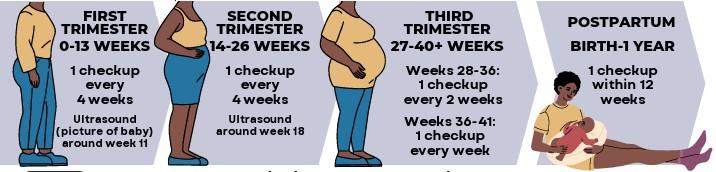
Everyone's pregnancy is different.
Full-term pregnancy is usually 38-42 weeks long.
- Full Term Pregnancy: Babies do best when they are born during weeks 39-40.
- Preterm or Premature Baby or Preemie: A baby born before week 39.
- Miscarriage: The unplanned loss of pregnancy before week 20.
- Stillbirth: The loss of pregnancy at or after week 20.
Everyone's birth experience is different.
- Vaginal Birth: The baby is pushed out of the uterus through the vagina.
- Cesarean or C-Section: The baby is lifted out through surgical incisions made in the abdomen and uterus. Anesthesia is used to numb the lower half of the body.
- VBAC: A vaginal birth by someone who has had a C-section in a previous pregnancy. Your doctor will determine if you are eligible.
Everyone responds to labor differently.
Medication: There are medications to relieve labor pains and medications to start or strengthen labor. Ask your doctor for information before your due date so you can make informed choices about these medications when the time comes.
Natural: Having a vaginal birth without pain medication or routine medical interventions is possible. If you want a natural birth, find a health care provider that supports your choice.
Care Providers
OB or OB/GYN or Obstetrician: A doctor who specializes in pregnancy, birth and delivery. An OB treats medical conditions during pregnancy and performs surgery related to birth. OB/GYNs may deliver babies at hospitals or licensed birthing centers. OB/GYN care and delivery is covered by Medicaid and insurance.
Midwife or Nurse Midwife: A trained health professional who provides medical care during pregnancy, birth and postpartum. A Midwife cannot perform surgery. A Midwife may deliver babies at hospitals and birthing centers or perform home births. Midwifery care is covered by Medicaid and some insurances.
More care providers to learn about:
- Birth doula
- Certified Lactation Consultant
- Childbirth educator
- Chiropractor
- Community Health Worker
- Dietitian
- Family Nurse Practitioner
- Pediatrician
- Postpartum doula
- Social worker
- Ultrasound Technician (Sonographer)
- Acupuncturist
- Massage Therapist
Check out Your Guide to a Healthy Birth for a ton of detailed information about pregnancy, birth and postpartum.
Providers: You Deserve to Feel Safe and Supported through Pregnancy
You should feel confident that your provider listens to you, believes you and takes action on any of your concerns, signs or symptoms during and after pregnancy. A doula may be able to help you voice your concerns. If you feel your concerns are not being taken seriously, you may need to find a new provider. It is possible to find a new provider at any point during pregnancy. Contact Medicaid or your insurance to find out what your options are.
Anyone can experience complications during pregnancy and labor
You can avoid some pregnancy complications by maintaining a healthy lifestyle, keeping track of signs and symptoms and sharing how you are feeling with your provider. Any physical or mental health issue that affects a pregnant or postpartum person, their baby or both is called a complication. Anyone can have complications, even if they had healthy pregnancies before. The risk of complication is higher for anyone who has a health issue before becoming pregnant. It is possible to have a health issue that you do not know about.
The most common complications are high blood pressure or preeclampsia, gestational diabetes, preterm labor and miscarriage. Other important issues to be aware of are low birth weight, infection, bleeding and mental health issues, including postpartum depression and psychosis. These complications can come up during pregnancy or labor or after your baby is born. It is important to share any signs or symptoms of complications with your provider. Your loved ones and peers may notice signs and symptoms before you do. Make sure your provider is taking your concerns seriously.
If you are having serious symptoms, call 911.
Risk Factors for Complications
- High blood pressure
- Diabetes
- Cancer
- Infection
- Age
- Weight
- Smoking
- Drinking alcohol
- Substance use
- Stress level
- Diet
- Mental Health
Eating Healthy Helps: Health.Gov has some simple tips on eating healthy including foods to avoid during pregnancy.
Birth and Parenting Education
Most health care providers offer connections to important birth and parenting classes. Some providers require birth education as part of the care they provide during pregnancy. Medicaid and most insurance plans will cover fees for a few basic classes covering birth and breastfeeding or chestfeeding. Ask your care provider for more information. Ask a local librarian for up-to-date books on childbirth and trusted online resources. Our local libraries have many great resources.
Discuss what you learned with your doula and anyone that will attend your birth. Encourage others to attend classes, too. Anyone caring for your baby should learn infant CPR.
Subjects to learn about:
- Childbirth
- Infant CPR
- Breastfeeding or chestfeeding
- Safe sleep
- Parenting
- Car seat installation
- Successful pumping
- Baby weaning
Doulas Do Make a Difference
A doula (say doo-luh) is trained to provide continuous informational, emotional and physical support to pregnant people and their families during pregnancy, childbirth and the postpartum period. Doulas do not deliver babies but can be part of your birth team. Doula services are in addition to a health care provider. Doula services are covered by Medicaid and many insurance plans.
Doulas have skills that will help you and your family have a positive birth experience. Your doula can:
Help you create a calm birth environment for you and anyone attending your birth Provide encouragement and information to make sure you feel safe and supported through any decisions that come up before, during or after labor and childbirth Use soothing touch and other comforting skills to reduce labor discomfort and pain Help partners supporting birthing parents during labor Be with you in the birthing room with you through active labor and childbirth Provide breastfeeding or chestfeeding support, postpartum care and much more.
It is important to find a doula you can connect with. Ask potential doulas about their training, how many births they have attended and what services they provide. Book your doula as early in your pregnancy as possible. Together, you will create a plan for birth and postpartum that reflects your culture, values, concerns, and needs. A doula is there for you every step of the way.
Evidence shows that support from doulas may be connected with:
- Fewer negative birth experiences
- Lower preterm birth rates
- Fewer birth complications
- A decrease in the length of labor
- A decrease in the use of pain medication
- Reduced number of C-sections
- Higher newborn APGAR (Appearance, Pulse, Grimace, Activity, Respiration) scores
- An increase in the number of parents breastfeeding or chestfeeding newborns
A doula is a great advocate for you and your baby. Ask your health care provider and the people in your community about their favorite doula service.
Doula Match online allows you to search for doulas by ZIP code, due date and insurance. They also have options to search for Black, Indigenous and multilingual doulas. Find a list of doulas here: doulamatch.net
Create a Birth Plan
A birth plan is a good way to start conversations with your provider and birth team about your intentions for labor and childbirth. There are a lot of options when it comes to birth. Understanding the options will help you make the best decisions for you and your baby. Remember to be flexible. Consider issues that may come up. Have alternative plans in place. Every birth is different. In some cases, your provider might suggest an intervention, like inducing (starting) labor, to help you deliver your baby safely. Interventions are actions taken by health care providers to help you with the birth of your baby. Not all interventions are necessary. Being informed and planning ahead will reduce the pressure you may feel to use interventions you are not comfortable with.
Birth Plan Templates: English | español (Spanish) | عربى (Arabic) | বাংলা (Bengali) | Kiswahili (Swahili) | မြန်မာဘာသာ (Burmese)
Topics to Research and Discuss with your Provider
- Laboring at home
- Vaginal exams during labor
- Electronic fetal monitoring
- Inducing labor options before and after due dates
- Nonstress tests
- Episiotomy (a cut to widen vaginal opening)
- Pain relief options
- Birth positions and pushing
- C-sections: When they are necessary
- Advocating for yourself in a hospital setting
- Who is allowed in your birth room
- Amenities in the delivery room: Birthing ball, birthing stool, shower, lighting, music, etc.
- Cord clamping, skin-to-skin contact, baby's first bath and other routine procedures following birth
Not All C-Sections Are Necessary
In Erie County, one out of every three births are by Cesarean section (C-section). In the U.S., rates of C-section are higher among Black, Indigenous and Asian parents. Studies show that around half of all C-sections in the U.S. are unnecessary. C-section surgery is not necessary for most low-risk pregnancies. Unnecessary C-sections can have more risk than benefit. Plus, parents who have C-sections are more likely to have repeat procedures in future pregnancies.
If your provider is recommending you schedule a C-section, it is important to understand if surgery is absolutely necessary. In limited emergency situations, C-section can be life- saving for the parent and baby.
Ask your doctor: why is a C-section necessary for me?
If your health care provider is suggesting you schedule a C-section, ask questions. Ask your provider to explain the evidence-based reasons why C-section is necessary for you. Evidence-based means the reason is connected to current scientific research that shows the outcome is better for the parent and/or baby if a C-section is performed instead of a vaginal birth. You can ask your provider to speak slowly and to use plain language to help you understand. It is your provider's job to make sure you feel safe and fully understand any risks with your birth.
Ways to lower your risk of an unnecessary C-section
Taking a childbirth class can help you have a successful vaginal birth. Ask your provider or doula for information about childbirth education. Ask a local librarian for books on childbirth and trusted online tutorials. Find out what types of classes are covered under your insurance or Medicaid plan.
Choose your health care provider carefully. Your provider should be able to talk about how they will support you having a vaginal birth. They should know their C-section rates and be able to explain them to you. If the provider is dismissive about these questions, you may want to find a new one.
Get support during labor. Parents who have continuous support during labor, from someone other than family and friends, are less likely to need intervention like C-section. Contact your insurance to find out if they cover doula care.
Understand the risk level of your pregnancy. If you are having a low risk pregnancy, C-section is likely unnecessary. Look out for providers that are rushing to induce labor or jumping to conclusions about the possibility of a large baby to justify surgery. Ask for evidence that shows that C-section is medically necessary for you.
Choosing a Pediatrician
A pediatrician is a medical doctor who treats infants, children and young adults. They provide annual checkups, vaccinations and support when your child is sick, and refer to health care specialists when children experience serious illness. Choose a pediatrician who you can trust. Some things to consider when looking for a provider include: office location, hours open, insurance plans accepted and which are doctors accepting new patients.
Bring the following information about your baby's provider with you to your birth:
- Provider's Name
- Address of Office
- Phone and Fax
- Email address
Health Insurance
In New York State, all children are eligible for either Children's Medicaid or Child Health Plus. Choose a pediatrician before your baby is born. The cost (also called a premium) is determined by your monthly household income and family size. Many families in Erie County are eligible for free coverage. Families with somewhat higher incomes pay a monthly premium of $15, $30, $45 or $60 per child per month, depending on income and family size. For larger families, these rates are capped at the cost of three children.
There are no co-payments for services under Child Health Plus, so you will not have to pay anything when your child receives care through these plans. For more information or to apply, call 1-800-698-4543 or visit nystateofhealth.ny.gov. Make sure to include expected children in your household size.
The First Few Days After Birth
Once your baby is born, your health care provider will complete some basic procedures.
Delivery Room Procedures
Delivery room procedures are steps your health care provider will take to make sure your baby is safe and healthy following childbirth.
- Cord clamping. Your umbilical cord will be clamped and detached from the placenta. You may choose to wait to clamp until the cord has stopped pulsing. The stump that remains clamped on your baby will fall off as it heals, a few weeks after birth.
- Basic exam. Your provider will examine your baby for any obvious problems.
- APGAR score. Your baby will be evaluated on Appearance, Pulse, Grimace, Activity and Respiration and given a number score. You can ask your provider more about the meaning of the score your baby receives.
- Weight and measure. Your provider will record your baby's birth weight, length and exact time of birth for the birth certificate. Vitamin K dose. All newborns have slightly low levels of vitamin K, which is needed for normal blood clotting. Research shows that a vitamin K shot at birth protects your baby from developing dangerous bleeding which can lead to brain damage and even death.
- Antibiotic. To reduce eye infection, your baby will receive antibiotic eye ointment or drops. Erythromycin is commonly used.
- Hepatitis B vaccine. All babies should get the first shot of hepatitis B vaccine within 24 hours of birth. This shot reduces the risk of your baby getting the disease from you or family members who may not know they are infected with hepatitis B.
- Labeling. If you deliver your baby in a hospital, parents and baby will receive matching bracelet labels.
Newborn Screenings
Newborn screenings test for serious but rare and mostly treatable health problems at birth. Newborns with one of these disorders may look healthy at birth. This is why testing is so important. The earlier treatment is started, the better the outcome for your baby. Screening helps identify if any health problems are present. Further testing may be required.
These tests typically happen in the hospital or at health care offices in the first few days following childbirth. Your health care provider may carry out the tests or give you a referral to see a pediatrician or specialist.
- Heel prick blood test. Your health care provider will prick your baby's heel to get a few drops of blood to test. The blood is used to screen for 50 different disorders. Most newborn babies will not have one of these disorders.
- Hearing screening. This test checks for hearing loss using headphones and a computer to see how your baby responds to sounds.
- Heart screening. This test screens for critical congenital heart defects (CHDs or CCHDs). Using sensors on your baby's skin, called pulse oximetry, your provider will check the amount of oxygen found in your baby's blood. For more information on newborn screening, translated in 14 languages, check out New York State Department of Health here: bit.ly/NYSDOHnewbornscreening
Vitamin K: The Facts
Vitamin K is used by your body to stop bleeding and form blood clots. All babies are born with low levels of vitamin K. Babies cannot make enough vitamin K to form blood clots. This can cause Vitamin K Deficiency Bleeding (VKDB). VKDB can result in brain damage, permanent disability or death. A vitamin K shot at birth is the best way to make sure all babies have enough vitamin K.
Even if you eat lots of foods rich in vitamin K while pregnant, it is still not enough to prevent VKDB. Breast milk will not have enough vitamin K to prevent VKDB. Babies who do not get vitamin K when they are born are 81 times more likely to develop severe bleeding than babies who do. The vitamin K shot is safe. For more information, visit NY State's Department of Health Page on Vitamin K.
Postpartum Care
Postpartum is the period following childbirth. This stage can last up to one year. It is normal to feel overwhelmed during the postpartum period. Often, a parent's health and wellbeing are overlooked during the postpartum period. It is important to plan ahead for postpartum. Planning ahead will help reduce stress and allow for deeper connection with your newborn. Planning ahead will ease the transition into parenting.
Practices that help you heal
Life with a newborn baby is unpredictable and exhausting. Set postpartum goals that support getting as much rest and nutrition as you can.
- Create a postpartum support network. Think about the people in your life that you love and trust. Before your baby is born, ask these people if you can count on them for help. Let them know what kind of help you are open to and how they can offer their support.
- Make rest a requirement. Taking rest when you can is important. If you are co-parenting, discuss how you will share responsibilities overnight. Think about how you can rely on your support network for help with resting. Look into postpartum doula care.
- Accept community meals. Let your community cook for you. Request meals that are nutrientdense and easily digested, like lean meat, fish, broth, leafy greens and beans.
- Talk about your mental health. It is normal to feel sad, tired, anxious and moody following childbirth. These symptoms are sometimes called baby blues and should go away. Talk to someone you trust about your feelings. If you feel afraid, guilty, panicked or have scary thoughts, contact your provider or call or text 1-833-943-5746 to talk with someone.
MEAL TRAIN: Organize meals for yourself or friends using this free and simple online tool: mealtrain.com
Postpartum Health Care
Most providers offer 1-2 postpartum checkups. You should see your health care provider within twelve weeks of childbirth, but less than half of birthing parents attend their postpartum visit. The postpartum visit with your health care provider is a critical time to: discuss family planning and contraception assess mental health asses physical recovery from childbirth adjust management of chronic health problems. Discuss family planning and contraception Talk about your mental health Assess physical recovery from childbirth Adjust management of existing or new chronic health problem
Warning Signs of Complications
Anyone can have postpartum complications, even if you have had healthy postpartum periods before. Ask those around you to look for signs of complications and check-in with you about your physical and mental health. Call your health care provider if you have:
- Heavy bleeding (more than your normal period or gets worse)
- Blood clots the size of an egg
- An incision (cut from C-section) or wounds from vaginal birth that appear infected, are painful or not healing
- Intense sadness and worry that lasts a long time after birth
- A red or swollen leg or calf that is painful or warm to the touch
- Temperature of 100.4 F (38 C) or higher
- A headache that does not get better after taking over-the-counter medication
- Vision changes
- Pain or burning when going to the bathroom
Go to the emergency room if you have:
- Bleeding that cannot be controlled
- Chest pain
- Difficulty breathing or shortness of breath
- Thoughts of hurting yourself or your baby
- Seizures or seeing spots
It Is OK to Not Be OK
1 in 5 birth parents experience postpartum depression (PPD) and other mental health issues after childbirth. Strong feelings of sadness and worry can make parenting and selfcare difficult. PPD is not your fault. It does not make you a bad parent. If you don't feel like yourself after childbirth, tell your provider or someone you trust. You can also call or text the National Maternal Mental Health Hotline at 1-833-943-5746.
Resources
Family Planning
Jesse Nash Health Center 608 William Street Buffalo, N.Y. 14206 (716) 858-2779
Appointments encouraged but walk-ins are welcome
Planned Parenthood Locations in Buffalo & West Seneca
1-866-600-6886
Prenatal and Parenting Support
Buffalo Prenatal Perinatal Network, 625 Delaware Avenue, Suite 410 Buffalo, N.Y. 14202
Birth and Parenting Education, Community Health Workers, Affordable Care Programs and Referrals
Durham's Maternal Stress-Free Zone, 200 E Eagle Street Buffalo, N.Y. 14204 (716) 884-6711
Walk-in Wednesdays 5:30-7:30pm
Erie Niagara Area Health Education Center (AHEC): Birth Equity Project
Jericho Road Community Health Center: Priscilla Project (716) 835-9358 ext. 102 (716) 886-0771
Multilingual services available; multiple locations
Melinated Moms, (716) 245-5394
Apply For WIC
Catholic Charities: (716) 218-1484. Locations across Erie County.
Basic food support for qualifying pregnant and postpartum women and children up to age 5.
Note: WIC does not require US citizenship, social security number, green card or legal residency to receive benefits.
Baby Care Support
Nursery Equipment, Clothing, Diapers and More
Every Bottom Covered: (716) 896-7021
Family Help Center, 24-Hour Family Helpline: (716) 892-2172
Harvest House Children & Baby Ministry, By appointment only: (716) 824-7818
New York Milk Bank Locations across Erie County: (212) 956-MILK
Baby Café USA Free breastfeeding support