 Erie County Dept of Health
What is Health Literacy?
The U.S. Department of Health and Human Services and its Healthy People 2030 campaign define health literacy as:
- Personal health literacy is the degree to which individuals have the ability to find, understand, and use information and services to inform health-related decisions and actions for themselves and others.
- Organizational health literacy is the degree to which organizations equitably enable individuals to find, understand, and use information and services to inform health-related decisions and actions for themselves and others.
- Health equity is the attainment of the highest level of health for all people. We will achieve health equity when everyone has the opportunity to be as healthy as possible.
Literacy in Erie County
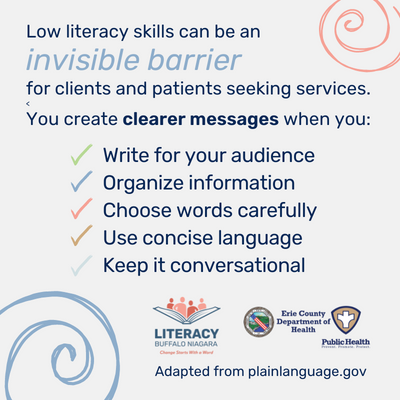
Nearly 150,000 adults in Erie County have a hard time reading and writing the English language. When someone struggles to read English, they will also struggle to understand written instructions from physicians, prescription information, public health and safety messages, and other material that informs health-related decisions. Literacy is a survival skill individuals need to make informed health decisions.
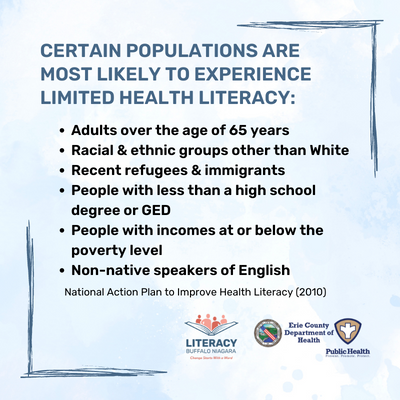
- The National Action Plan to Improve Health Literacy (2019) listed these populations as more likely to experience limited health literacy:
- Adults over the age of 65 years
- Racial and ethnic groups other than White
- Recent refugees and immigrants
- People with less than a high school degree or GED
- People with incomes at or below the poverty level
- Non-native speakers of English
Resources for People with Lower Literacy Skills
Tutoring and education are one part of the health literacy puzzle. Individuals can access one-on-one literacy tutoring from Literacy Buffalo Niagara. Buffalo Public Schools Adult Education Program also provides services for adult learners seeking to improve their literacy skills.
Decode Your Health
In recognition of Health Literacy Month, the Erie County Department of Health and the Erie County Department for the Aging, in partnership with Literacy Buffalo Niagara, are proud to launch “Decode Your Health,” a public education campaign aimed at improving digital health literacy across the community.
Health Literacy Month, observed nationally each October, highlights the importance of making health information easy to understand and use. This year’s “Decode Your Health” theme emphasizes the critical role of digital literacy in navigating today’s complex healthcare landscape.
The campaign includes shareable online resources (please see our Social Media Toolkit) and University Express sessions, focusing on older adults who may face unique barriers to digital access and understanding.

What Can My Organization Do to Support Health Literacy?
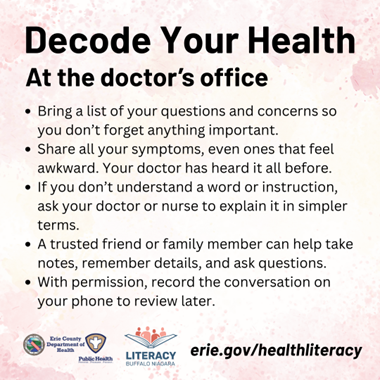
Low literacy skills can be an invisible barrier for clients and patients seeking services. Organizations should create their communications using the clearest language possible. Take into account forms, fact sheets and instructional materials. Plainlanguage.gov, a federal government resource, offers these suggestions for writing with clarity:
- Write for your audience
- Organize information
- Choose words carefully
- Use concise language
- Keep it conversational
A significant part of Erie County’s population has low literacy skills. Organizations can consider making staff aware of this countywide issue. If staff encounter clients or patients who appear to have low literacy skills the best way to communicate with them is through plain and simple language.
It’s best to have a plain language document that contains important information about your services readily available for patients and clients. Clear language will also make translation to other languages quicker. Having documents translated to languages commonly used by clients or patients can also help you immediately communicate with someone who is not proficient in English. Providing information on local literacy programs - and a phone number to call - can give someone the tool to access literacy resources and to better advocate for themselves.
The Centers for Disease Control and Prevention (CDC) offers free health literacy and plain language trainings. This training is appropriate for most organizations’ employees, especially those who create written documents and communications.
Media
- Buffalo News, Another Voice: Health literacy is an urgent issue for many Western New Yorkers
- Audio Recording: WBFO, Buffalo, What's Next? with Office of Health Equity Director, Kelly Wofford, and Literacy Buffalo Niagara Marketing and Outreach Manager, Marissa Colosanti. (11/3/2022)
- Erie County Legislature Resolution: "Acknowledging and Recognizing Health Literacy Week" (10/6/2022)
- ECDOH Press Release: Erie County Department of Health (ECDOH) and Literacy Buffalo Niagara partner to promote health literacy awareness during October (10/17/2022) | El Departamento de Salud del Condado de Erie se asocia a Alfabetización Buffalo Niagara para promover la concientización sobre la alfabetización en salud en octubre
- Video: 5 Things to Know About Health Literacy, a short video, from the U.S. Department of Health and Human Services, for proven strategies to make health information and services easier to find, understand, and use in your organization.
- Printable PDF: Do You Know Your Health Numbers?
Additional Resources
- Literacy Buffalo Niagara
- Buffalo Public Schools Adult Education Department
- Gerard Place
- Plain Language Materials & Resources Centers for Disease Control and Prevention (CDC)
- Trainings on Health Literacy and Plain Language Centers for Disease Control and Prevention (CDC)
- Erie County Office of Health Equity
Some materials on this page were developed in partnership with Literacy Buffalo Niagara.


Social Media Toolkit Materials
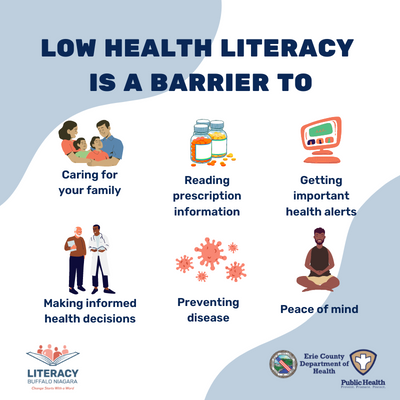
We welcome the appropriate use of this "Decode Your Health" toolkit by other organizations. Graphics and text can be used on social media platforms. We appreciate links back to this page and attribution to “Erie County.”
| Image | Copy |
|---|---|
|
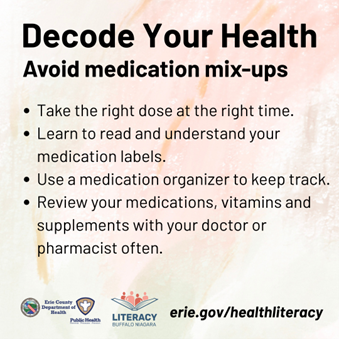
Decode your health: Avoid medication mix-ups! Do you take any medication? Mistakes when taking your medicine can make you sick or cause serious harm. Keep these tips in mind!
More information at our Health Literacy web page, from our Erie County Department for the Aging and Literacy Buffalo Niagara. p> |
|
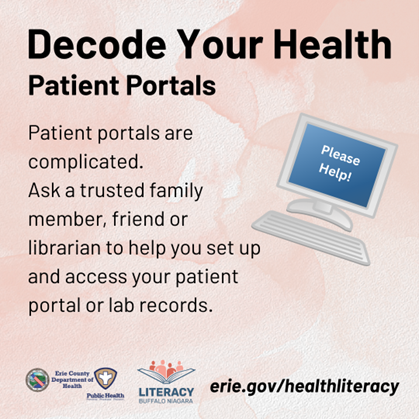
Decode your health: Patient portals can be tricky! Do you need help setting up or using your patient portal or checking lab results? Ask a trusted friend, family member, or even your local librarian for help. You don’t have to figure it out alone! More information at our Health Literacy web page, from our Erie County Department for the Aging and Literacy Buffalo Niagara. https://www.erie.gov/healthliteracy |
|
|
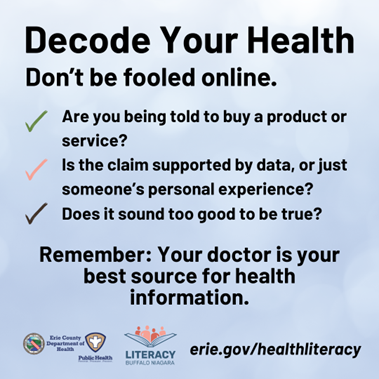
Decode your health: Don’t get fooled online! Before you trust a health tip or product from a so-called “influencer,” ask yourself:
When in doubt, talk to your doctor. They’re your best source for health info. More information at our Health Literacy web page, from our Erie County Department for the Aging and Literacy Buffalo Niagara. https://www.erie.gov/healthliteracy |
|
|
Decode your health at the doctor’s office! Make the most of your visit with these simple tips:
More information at our Health Literacy web page, from our Erie County Department for the Aging and Literacy Buffalo Niagara. |