 Environment & Planning
Extreme Temperature Plan
As climate change progresses, we are seeing weather become more extreme. Erie County Department of Environment and Planning in partnership with the University at Buffalo completed a Climate Vulnerability Assessment in 2023, which identified extreme heat as one of several priority threats to our community. Because climate change can also make winter weather more extreme, and because some of the ways to protect the community from extreme heat are similar to extreme cold, the County is developing an Extreme Temperature Plan for Erie County to address both heat and cold.
The Extreme Temperature Plan will include:
- A Thermal Vulnerability Assessment to identify risk factors and capacity gaps.
- Prioritized short, medium, and long-term action items for the County to reduce impacts.
- A review of Ready Erie and neighbor-to-neighbor approaches to support vulnerable people during extreme heat events.
- Updated protocols and procedures for the county's response to extreme temperature events.
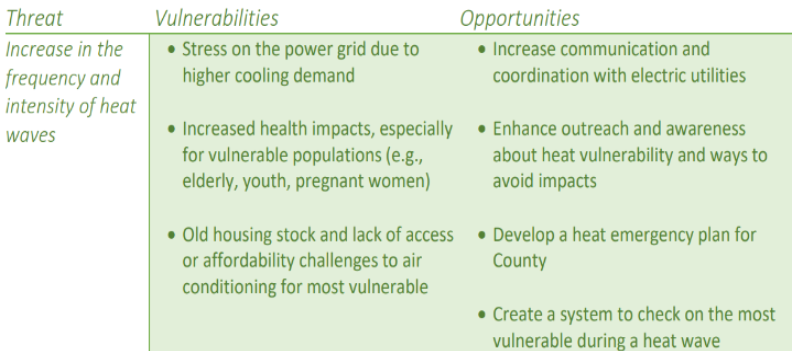
In January 2026 a Draft Thermal Vulnerability Assessment (TVA) was released for public comment. It will do the following:
- Summarize projections of extreme temperature for Erie County
- Identify and explain risk factors that increase vulnerability to extreme temperatures
- Prioritize risk factors for Erie County using local data
By focusing on populations and areas in the County that are highly exposed, sensitive, and have the least resources and ability to adapt, this assessment will inform a more equitable, inclusive, and effective Extreme Temperature Plan for Erie County.
Comments on the Thermal Vulnerability Assessment should be emailed to sustainability@erie.gov.
Thermal Vulnerability Results
This thermal vulnerability assessment finds that Erie County is becoming increasingly exposed to extreme heat while remaining at risk for extreme cold. It also shows that vulnerability is unevenly distributed, and disproportionately effects the following groups:
- Seniors
- Young Children
- Pregnant Individuals
- People with Disabilities
- Those with Chronic Health Conditions
Adaptive capacity is also constrained for many residents, particularly those who are:
- Experiencing high energy burdens
- Renting their home
- Experiencing limitations in their access to transportation
- Experiencing barriers to information access
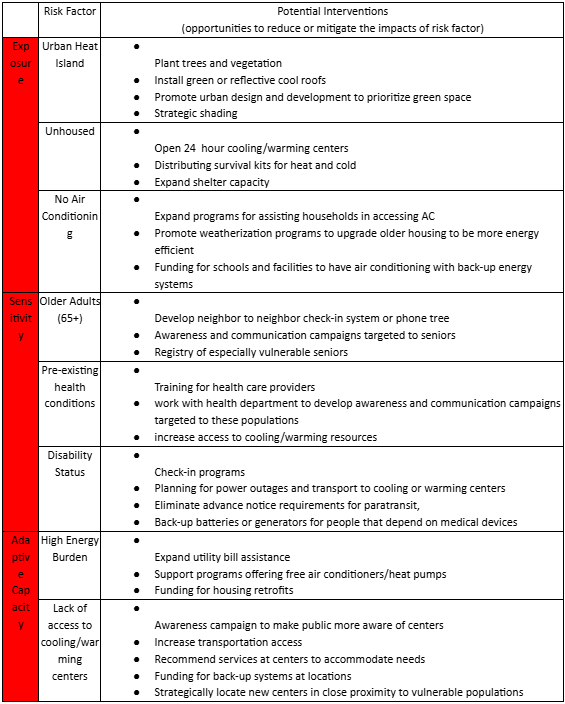
This table summarizes these priority risk factors across all three dimensions of vulnerability, including opportunities to mitigate the consequences of extreme heat and cold on residents that are impacted by these factors.
Community Engagement
Community engagement is a key aspect of the plan. The County is working with the Community Organizations Active in Disaster (COAD) to receive stakeholder feedback. We are also conducting public meetings and participating in tabling events. Please consider taking our Extreme Temperature Survey to let us know how extreme weather is affecting you, and to give us your thoughts on what actions should be included in the County's plan.
Funding
This project has been funded in part by the Climate Smart Community Grant Program, Title 15 of the Environmental Protection Fund through the New York State Department of Environmental Conservation.
More Information
Information on how to stay safe during extreme heat and cold events can be found on the following Erie County Health Department Pages:
Extreme Heat: Extreme Heat | Erie County Dept of Health
Extreme Cold: Winter Storms & Extreme Cold | Erie County Dept of Health
What can you do to help support Erie County's efforts?
Email sustainability@erie.gov to take part in our heat survey