 Erie County Dept of Health
Content on this page was developed in partnership with the Alzheimer's Association for our publication “Let’s Talk About Brain Health.” None of the information on this page should be used as a substitute for direct medical advice from your health care provider.
This publication is available in six languages. You may order paper copies of this or any of our other publications, using this form. Printable PDF versions in all 6 languages are for download using the links below. For accessibility, please use the web version of this content.
Printable Version of "Let's Talk About Brain Health"
Let's Talk About Brain Health
Each day, we make choices that impact our brain health later in life. There are changes you can make at any age to protect your brain.
About 1 in 9 Erie County residents ages 65 and older are living with Alzheimer's disease. Alzheimer's is a brain disease that causes a slow decline in memory, thinking, and reasoning skills, and can eventually lead to death. Reducing risk factors throughout your life may delay brain health challenges. It’s never too early or too late to start thinking about your brain’s health.
Why Brain Health Matters
Your brain impacts all areas of your life, from your emotions to how your body moves. Cells called neurons communicate with other areas of your body to keep things running smoothly. Think of your brain as a supercomputer. It processes information and controls everything from your movements to your thoughts.
As you get older, your brain begins to show normal signs of aging like occasionally forgetting what day it is and then remembering later. It can be difficult to know when these changes are normal or when they could mean something more serious is happening. It is important to keep regular appointments with your health care provider so they can help you track any changes.
Taking Care of Your Brain
While there are some things that you cannot control when it comes to your brain health, there are some changes you can make now that may help to lower your risk of developing dementia and Alzheimer’s disease.
Research has found that there is a link between heart health and brain health. Doing things to keep your brain healthy could also keep your heart healthy. No matter your age or health status, you can take steps now to protect your brain. The foods you eat, how often you move your body, and how often you talk to or interact with other people can all impact brain health.
Brain Health Terms
Cognitive Ability: The ability to learn, remember, and understand. This includes following directions, solving problems, or remembering a friend’s birthday. It can also include awareness, reasoning skills, judgement, intuition, and language.
Cognitive Engagement: How we keep our minds active, like listening to music, hobbies, and spending time with friends.
Normal Cognitive Aging: Normal cognitive aging often comes with slower thinking and can include changes in memory, difficulty paying attention, and difficulty remembering new information in your mind, like a grocery list or remembering an appointment.
Cognitive Decline: Changes in the ability to think that occur as a person ages. Some change is a normal part of aging, but a big change could be a sign of a brain health concern.
Mild Cognitive Impairment: An early stage of memory loss or other noticeable brain health changes such as the ability to learn, understand, or communicate in someone who is still able to perform most daily tasks without help.
Dementia: Dementia is a general term for loss of memory, language, problem-solving, and other thinking abilities that are severe enough to interfere with daily life.
Alzheimer's is the most common type of dementia. Dementia is not a single disease. It is the general term that describes a collection of symptoms that can be caused by a variety of diseases. These diseases cause damage to brain cells. When brain cells cannot communicate normally, someone’s thinking, behavior, and feelings can be affected.
Alzheimer's Disease: A type of dementia that causes problems with memory, thinking, and behavior.
Early-onset Alzheimer's: Early-onset, or sometimes called younger onset Alzheimer’s, is Alzheimer’s disease in someone younger than 65 years old.
What is Alzheimer's Disease?
Alzheimer’s is a brain disease that may cause problems with memory, thinking, and behavior. It is the most common cause of dementia, a general term for memory loss and other symptoms that are severe enough to interfere with daily life. More than 7 million Americans live with Alzheimer’s disease.
Alzheimer’s usually progresses slowly in three stages: mild, moderate, and severe. Over time, memory loss worsens as individuals become unable to have conversations or respond to their environment. Alzheimer’s affects people in different ways. Each person may experience the stages of Alzheimer’s differently.
Risk Factors
There are multiple risk factors that cause Alzheimer’s disease and other dementias. Most cases of Alzheimer’s and other dementias result from a combination of risk factors.
- Age: Increasing age is the greatest risk factor for developing Alzheimer’s and other dementias. Most people with Alzheimer’s are 65 years old or older. While the risk of Alzheimer's disease increases as you age, it is not directly caused by getting older.
- Family History: Risk of developing Alzheimer’s increases for those who have a parent or sibling with the disease. This risk increases further if more than one family member has Alzheimer’s. Having a parent or sibling with Alzheimer’s does not necessarily
mean you will develop Alzheimer’s. - Genetics: Humans pass genes from parent to child. If you have a gene that causes Alzheimer’s, you are at greater risk for developing the disease.
- Head Injury: There is a link between a history of head injuries and an increased risk of dementia. A concussion is an example of a head injury.
- Certain Medical Conditions: There is a connection between brain health and heart health. Many of the same conditions that impact heart health also impact brain health.
- Early Detection Matters: While there is no known cure for Alzheimer’s yet, there are approved medications that can slow the disease down. An early diagnosis gives you access to more treatment options and more time to plan for the future. Schedule routine appointments with a primary care provider to track brain health changes.
Changes You Can Make
You can lower your risk for cognitive decline through the choices you make each day.
10 Healthy Habits for Your Brain
- Challenge your mind and keep learning: Participate in activities that expose your mind to new topics. You can do this by trying a new hobby, learning a new skill, or studying a new language. You can also play brain-challenging games like chess, tabletop games, video games, word puzzles, jigsaws, crosswords, sudoku, and memory games. Try a variety of challenges to see what you enjoy. Choosing activities you like will help keep you interested.
- Buffalo and Erie County Public Library: Do something new! Learn a new skill or try something artistic. Challenging your mind may have short- and long-term benefits for your brain health.
- Erie County University Express: Education reduces the risk of cognitive decline and dementia. Encourage youth to stay in school. Continue your own education by taking classes at your local library or college or online. Your municipality may offer free community education classes and workshops.
- Stay connected: Socializing can boost attention and memory and help to strengthen brain health. Spend time with family and friends, join a club or group, or get involved in your community.
- Get moving: Moving your body regularly can improve overall health, and reduce the risk of cognitive decline. It can improve memory and help you think, learn, and problem-solve. Find ways to build more movement into your day and engage in activities that raise your heart rate. An increased heart rate increases blood flow throughout your body and to your brain, carrying extra nutrients important to your brain’s health. Try walking, dancing, stretching, gardening, playing sports, doing housework, mowing the lawn, swimming, or bicycling.
- Protect your head: Head injuries increase Alzheimer’s risk. Help prevent head injury by wearing a helmet when biking or playing sports. Wear a seat belt when in the car. Do what you can to prevent falling.
- Be smoke free: Many people use cigarettes, alcohol, cannabis or other substances to deal with stress. These things can cause serious health problems. People who quit smoking can lower their risk of cognitive decline.
- Manage Your Blood Pressure: You can manage your blood pressure by making heart healthy food choices, moving your body, and discussing medication management with your doctor. However, sometimes stress has a big impact on blood pressure.
- Manage Stress: Choose positive ways to manage stress like meditation, journaling, talking to a trusted friend, or practicing hobbies you enjoy. Your local library has tons of great hobby ideas. Practice mindfulness through deep breathing, listening to music, or finding a quiet moment to relax.
- Eat more fruits and vegetables: Eating healthier foods can help reduce your risk of cognitive decline.
- Manage diabetes: Type 2 diabetes can increase your risk of Alzheimer’s. Risk also increases with the length of time someone has diabetes and how severe it is. Work with your health care provider to find out about testing and treatment options.
- Get enough sleep: Quality sleep is important for brain health. Create a bedtime routine to help you wind down before bed.
- Limit screen time before bed.
- Find a comfortable temperature for sleep.
- Try to limit things that will disrupt your sleep, like noise and light.
10-10-3 Challenge Printable Resource
The 10-10-3 Brain Health Challenge helps you learn the 10 early signs and symptoms of dementia, 10 healthy habits for brain health, and 3 habits you can pick to follow.
Download 10-10-3 Challenge Printable PDF (English) | Descarge Volante del Desafío 10-10-3 Para la Salud Cerebral (Español)
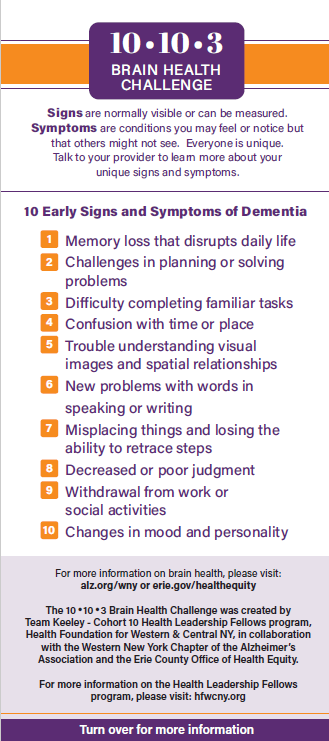
10 Early Signs and Symptoms
Signs are normally visible or can be measured. Symptoms are conditions you may feel or notice but that others might not see. Everyone is unique. Signs of good health for you may be different from someone else. Your overall health may also be impacted by medications, health conditions and family history. Contact a health care provider if you notice any of these signs in yourself or a loved one. Talk to your provider to learn more about your unique signs and symptoms.
Memory loss that disrupts daily life
- Forgetting information you just learned
- Forgetting important dates or events
- Asking the same question over and over
- Relying on reminder notes, electronic devices, or family members to remember
A typical sign of aging: forgetting a name but remembering it later
Challenges in planning or solving problems
- Trouble making and following a plan
- Trouble keeping track of numbers
- Trouble concentrating
- Taking longer to do things than you did before
A typical sign of aging: making occasional mistakes when managing money or paying bills
Difficulty completing familiar tasks
- Daily tasks are harder to get done
- Trouble driving to a familiar place
- Forgetting the rules to a favorite game
A typical sign of aging: occasionally needing help to use microwave settings
Confusion with time or place
- Losing track of dates or seasons
- Trouble understanding something that is not happening in that moment
- Forgetting where you are or how you got there
A typical sign of aging: getting confused about the day of the week but figuring it out later
Trouble understanding visual images and spatial relationships
- Changes in vision that affect balance
- Trouble reading
- Trouble judging distance or color contrast that could affect driving
A typical sign of aging: vision changes related to cataracts
New problems with words in speaking or writing
- Trouble with following or joining a conversation
- Stopping in the middle of a conversation or repeating yourself
- Trouble naming a familiar object or using the wrong name for something. Example: calling a watch a “hand-clock”
A typical sign of aging: sometimes having trouble finding the right word
Misplacing things and losing the ability to retrace steps
- Putting things in unusual places
- Being unable to go back over your steps to find something that was misplaced
- Accusing someone of stealing a misplaced object
A typical sign of aging: occasionally misplacing something and retracing your steps to find it
Not participating in social or work activities
- Trouble keeping up with a favorite sports team or activity
- Withdrawing from hobbies or other social activities because of difficulty having or following a conversation
A typical sign of aging: sometimes feeling uninterested in family or social life
Changes in mood or personality
- Mood and personality changes
- Becoming confused, suspicious, fearful, or anxious
- Becoming upset easily at home, with friends, or when out of your comfort zone
A typical sign of aging: having very specific ways of doing things and becoming irritated when a routine is disrupted
Let's Talk: If you notice behavior, memory, or thinking changes in someone close to you, it can be difficult to know what to do or say. It is normal to be unsure or nervous about how to offer support. The Alzheimer’s Association has a guide to help you feel more confident and prepared to have a conversation and take action. For more information, visit: www.alz.org/10steps
Diagnosing Alzheimer's
It is important to tell your health care provider about any changes in your memory when you notice them. Getting checked by your doctor can help determine what is causing symptoms. If Alzheimer’s is the cause, an early diagnosis allows you access to treatment options, opportunities to participate in clinical trials, an opportunity to make choices to support brain health, and more time to plan for the future.
There is no single test that can tell if you are living with Alzheimer’s disease or another type of dementia. There are multiple ways your doctor can evaluate your memory and thinking. A brain health evaluation may require several visits to complete and you may need to see more than one doctor.
Some health conditions, like depression or sleep problems, can cause symptoms that look like dementia. Telling your health care provider about any signs or symptoms will help them decide if you are experiencing dementia or something else.
If you are concerned about Alzheimer’s disease, tell your doctor, “I have been noticing [name the symptom]. Can you check me for Alzheimer’s disease?”
What to Expect at Your Appointment
Your health care provider will ask you about signs or symptoms you have noticed. You can prepare to answer these kinds of questions:
- What signs or symptoms have you or someone close to you noticed?
- When did they begin?
- How often do they happen?
- Have they gotten worse?
Physical Exam and Medical History
Your health care provider will review your medical history and ask you about medical conditions that your family members have experienced. This helps them figure out if dementia or chronic illness runs in your family. During this visit, your health care provider may:
- Check your blood pressure, temperature, pulse, and weight
- Review all of the medications you are taking
- Ask you about your diet and if you drink alcohol, smoke, or use substances
- Ask you about your mental health history
- Listen to your heart and lungs
- Collect urine or blood samples for testing
- Recommend additional testing
It is important to be open and honest with your health care provider so they have all of the information they need to make a diagnosis.
Testing
Health care providers use many different tests to determine if someone has a form of dementia. Some of these tests may be performed by your primary health care provider. Other tests may be performed by an imaging technician, neurologist, or neuropsychologist.
Neurological Exams
During a neurological exam, a health care provider will look for signs of conditions other than Alzheimer’s that may impair memory or thinking.
Your doctor may test your:
- Reflexes
- Coordination, muscle tone, and strength
- Eye movement
- Speech
- Sensation (like touch, temperature, pain)
Depression Screen and Mood Assessment
Your health care provider will ask about your wellbeing to find out if your symptoms are caused by a mood disorder like depression. Mood disorders may cause symptoms that look like dementia.
Brain Imaging (MRI or CT)
Your health care provider may order brain imaging to look for signs of conditions other than Alzheimer’s. Brain imaging is painless but often takes around 30 minutes. Your provider may recommend one of two types of imaging tests:
A CT scan uses X-rays to provide detailed pictures of the brain.
An MRI uses radio waves and a large magnet to create detailed images of the brain. Your head will be inside a small space while MRI images are taken. The machine can be noisy.
Genetic Testing
Although genetic tests are available for some genes that directly cause Alzheimer’s, health care professionals do not recommend genetic testing. Genetic indicators of Alzheimer’s only account for a very small percentage of people living with Alzheimer’s.
Cognitive, Functional and Behavioral Tests
Cognitive and functional tests examine your memory, thinking, and problem-solving abilities. Behavioral tests assess changes in behaviors and symptoms. Some of these tests are quick, while others are longer and more complex. These tests typically have names with letters and numbers like AD8 and MMSE. Some cognitive testing may be done using a computer, tablet, or with electrodes (small plastic patches) placed on your scalp.
Cerebrospinal Fluid (CSP) Tests
CSF is a clear fluid in your brain and spinal cord. You can think of it as a cushion that protects your brain and spinal cord from injury. Alzheimer’s disease may cause changes in your CSF. Health care providers can take samples of CSF through a medical procedure, called a spinal tap or lumbar puncture, where a special needle is used to take the sample of fluid from the lower back. This procedure is done with numbing medication delivered by a shot in the area of the procedure.
Blood Tests
There are blood tests that may show changes in the brain, the presence of brain diseases, or brain damage. Health care providers who specialize in treating patients with memory problems can use blood tests along with other types of tests to diagnose and treat health issues.
Home Tests for Dementia Are Not Recommended: You may see ads for at-home tests for dementia. None of these tests have been scientifically proven to be accurate. A thorough examination by a health care provider is the best way to learn more about your brain health.
Staying Safe
If you or a loved one is diagnosed with Alzheimer’s disease, consider creating a safety plan. Your safety plan may change as the disease progresses. Starting to make changes to improve safety early on can help the person with Alzheimer’s feel less overwhelmed and stay independent longer.
Things to consider when making a safety plan
Home Safety
A person living with Alzheimer’s can live safely in their own home or a caregiver’s home with some simple and inexpensive changes. Here are some examples of changes you can make to improve the safety of your home for someone living with
Alzheimer’s:
- Use kitchen appliances with an automatic shut-off feature or smart home connection.
- Keep medications in a locked drawer or cabinet and restrict who has access.
- Install latches or deadbolts locks above or below eye level on doors so that it is less likely a person living with Alzheimer’s will exit through that door.
- Erie County Department for the Aging has a free home safety self-assessment tool.
Driving
At some point, a person living with Alzheimer’s will no longer be able to drive safely. As a caregiver, family member, or friend, plan to have a conversation about how to handle this when it happens and make a plan for who will make decisions about driving privileges. Look into different transportation options before driving is no longer a safe option. Talk with your health care provider about options for getting to health care appointments.
- A medical alert bracelet can help emergency service responders understand a person’s medical needs in an emergency situation.
Wandering
6 in 10 people living with dementia will wander at least once. One of the signs of Alzheimer’s is forgetting where you are or how you got there. People living with Alzheimer’s do not always recognize places that were once familiar to them and can become confused about where they are. Here are some tips to reduce the risk of wandering: Reassure the person if they feel lost, alone, or
confused.
If the person is no longer able to drive safely, remove their access to vehicles and car keys. Install bells above doors to signal when a door is opened or use smart home sensors to monitor when people enter or exit.
Safety Tips
- Medication safety
- Technology
- Traveling
- Abuse and neglect
Supporting Yourself While Caring for a Loved One
If you are a caregiver for someone living with Alzheimer’s or another dementia, it is important to take care of yourself. It is important to remember that there is stress that comes with caring for a loved one living with Alzheimer’s or another dementia and to take care of yourself too!
Support for Caregivers
Support groups offer confidential and caring environments where you can talk to people who are going through the same thing as you. There are in-person and virtual meetings. The Alzheimer’s Association offers local support groups and education programs for caregivers.
New York State Office for the Aging has support for caregivers.
Erie County Department for The Aging has support services for caregivers, including a calendar of free dementia respite programs and a home safety self-assessment tool.
EriePath: Erie Path is Erie County’s smartphone app that helps link people with resources that can benefit adults and caregivers.
211 WNY: 211 WNY is a 24/7, free and confidential link to health and human services information. Callers can connect to services related to mental health, support groups, emergency housing, and more. For more information, dial 2-1-1 or text 898211.
Build a self-care action plan
Being a caregiver can be stressful. As you care for your loved one, it is important to take care of yourself too. It can be hard to remember to do that in the moment, so consider creating a plan for ways to take care of yourself. This will look different from person to person. Do what works for you. Make a written list of things you can do to take care of yourself. Having this list will make self-care decisions easier when you are tired or stressed.
Things you can do to take care of your mind.
- Examples: Read a book or magazine, learn a new skill, play chess
Things you can do to take care of your feelings including grief.
- Examples: Journal, talk with a trusted person or a professional about your feelings. It is okay to grieve the life you knew before Alzheimer’s. For grief support, read Let’s Talk About Grief.
Things you can do to take care of your body.
- Examples: Stretch, go for a walk, keep routine appointments with your primary care provider, take a nap or head to bed early
Things you can do to build community.
- Examples: Spend time with friends, join a social group, attend a community event
Things you can do to nurture your inner beliefs and values.
- Examples: Meditate, pray, create a peaceful practice of your own
Wages and Support for Caregiving
Some government programs will pay wages for family or friends of people with disabilities to help with daily activities, including personal care, giving medicine, cooking, cleaning, and more. Other programs offer subsidy for transportation, meals, day care, and more.
Ways to receive wages and support for caregiving:
- Become a paid caregiver through the New York State Medicaid program.
- Get paid as a caregiver through a long-term care insurance policy.
- Apply for paid family leave through the New York State labor office.
- Look into the wide range of supports available from the local Area Agency on Aging (AAA), Erie County Senior Services.
- Apply for programs available to people caring for veterans, including wages for caregiving and respite services.
Find Your Local Alzheimer's Association Chapter
Call (716) 626-0600 or visit alz.org/wny
The Western New York chapter of the Alzheimer’s Association provides education programs, support groups, and other resources for those living with dementia and their caregivers in all eight counties of WNY, including Erie. You can contact your local chapter for many things, including:
Diagnosis and treatment: Your local chapter can provide a comprehensive list of providers that specialize in dementia diagnosis and care. They can answer questions you have about specific needs.
Support programs, education, and events: Your local chapter can provide information on support programs and connect you to educational materials and events that support people living with dementia and their caregivers.
For immediate help, call the Alzheimer’s Association 24/7 helpline: 1-800-272-3900
Helpful numbers to save in your cell phone contacts:
Upstate New York Poison Center: 1-800-222-1222
New York State Emergency Alerts: Text your county name (Erie) to 333111
988 Suicide & Crisis Lifeline: Dial 9-8-8
The Alzheimer’s Association 24/7 Helpline: 1-800-272-3900
More Brain Health Resources
The Alzheimer's Association leads the way to end Alzheimer's and all other dementia by accelerating global research, driving risk reduction and early detection, and maximizing quality care and support.
- The Western New York Chapter of the Alzheimer's Associationserves all eight counties of WNY - Allegany, Cattaraugus, Chautauqua, Erie, Genesee, Niagara, Orleans and Wyoming - with education programs, support groups, and other resources for those living with dementia and their care partners.
The New York State Department of Healthhas designated 10 Centers of Excellence for Alzheimer’s Disease (CEAD), which form a network of medical centers and teaching hospitals with experts in the diagnosis and care of individuals living with Alzheimer's Disease or other dementias, and for research and clinical trials. The University at Buffalo hosts the CEAD for Western New York.