A grant is an award of money that can be used to fund ideas, projects and programs to reach the goals of the community you live or work in. Grant awards generally do not need to be paid back. However, there are usually specific rules for applying for grants and for how grant funding can be used. Read on to learn more.
Finding the Right Funding
Does it Fit What You Need? Make a list of needs for your community or organization. Can this grant be used to fund the project you have in mind, or to fit another need?
Are You Eligible? Most funders will include information on what kinds of organizations or people are able to receive the funding.
Is This The Right Time? Do you have the time, people and other resources needed to apply before the deadline and to plan and complete the project if it is funded?
Types of Funders
Federal, State & Local Governments
Government grants tend to have more requirements and more complicated applications. The type of grant, who can apply and how to apply depends on the funder. Use these websites to search for funding opportunities:
Foundations
Foundation grants tend to be more specific and are based on the funder's preferences and priorities. Types of foundation funders:
- Community foundations
- Corporate foundations
- Family foundations
- Private foundations
Find Foundation Funding: Candid.org has a foundation directory that can be accessed for free at the Central Library branch in downtown Buffalo.
Types of Grants
Grant opportunities may be organized by who is eligible for funding or the types of activities that can be funded.
- Competitive grant: Funding is available and open to any organization that is eligible. Grants are awarded to applicants who plan a project and complete an application. Also called discretionary grants.
- Continuation grant: An extension or renewal of a grant that has been awarded before for a new grant period. Usually only available if you have received the grant before.
- Planning grant: Funding to create a plan for a new project is included. Funding to carry out the project may or may not be included. These grants are less common and clearly labeled.
- Program grant: Funding to carry out a new project or expand an existing project. Also called an implementation grant. Program grants may include a planning period. Most grants are program grants.
- Unsolicited grants: Some funders may accept grant applications even if they do not have an open RFA. Send a letter of inquiry (LOI) to see if they want to hear your grant proposal.
Grant Eligibility
Confirming whether or not you are eligible to apply for and receive a grant is important. It does not matter how great a grant is if your organization is not allowed to receive it.
STEP 1: Know what type of organization you represent or if you are applying as an individual. Types of organizations include:
- Nonprofits (organizations that provide a service or benefit to the community without focusing on earning profits)
- Small businesses
- Grassroots organizations
You can search for grants for your type of organization by searching for "nonprofit grants New York" or "small business grant."
STEP 2: Read the eligibility information from the funder. All funders will include information who is able to receive funding in the grant description.
STEP 3: Gather any documentation that is required to prove that you are eligible before beginning your application. If you are not eligible and do not have an eligible fiscal sponsor (learn more below), this is probably not the right grant for you. Keep searching for other grant opportunities. You can also consider options to increase your eligibility for grant funding opportunities.
Increase Your Eligibility
Most grants are only available to some groups. For example, many foundation grants are only open to 501(c)(3) nonprofit organizations, a group with a specific tax-exempt status. If you are having a hard time finding grants you qualify for, read on to learn about ways to increase your eligibility.
Apply for Nonprofit Status
501(c)(3) nonprofit organizations will be eligible for the most grants. 501(c)(3) and other types of nonprofit organizations are tax exempt, meaning they do not have to pay some taxes. To become a nonprofit organization, you must apply for tax-exempt status with the Internal Revenue Service (IRS), which takes time, effort and money. Additionally, nonprofits must keep detailed records and submit information to the IRS each year to keep their tax exempt status. For more information or to start this process, visit the IRS page on applying for tax exempt status.
Partner With Other Organizations
Another option is to work with an existing nonprofit whose mission is similar to your own. You can apply as a partnership with the nonprofit as the primary (main) applicant and share or split grant funds and responsibilities. You can also use a formal agreement called fiscal sponsorship to apply for grants under another organization's tax-exempt status. The fiscal sponsor is legally and financially responsible for the grant and typically reviews grant applications, documentation and reports. In exchange, smaller organizations often agree to provide a portion of the grant funds (such as funds for indirect costs) to the fiscal sponsor. Learn more about fiscal sponsorship.
Grant Terms to Know
Grants and their funders have their own words and rules. This makes applying for grants challenging. Below are definitions of common terms used by grant funders.
Request For Applications (RFA): A funder's written invitation for organizations to apply for available grant funding. Also called a solicitation, request for proposal (RFP), notice of funding opportunity (NOFO) or funding opportunity announcement (FOA).
Application or Proposal: Your formal request for funding, often using a special form provided by the funder. The organization, group or person who is completing the application or proposal is the applicant.
Grantor or Funder: An organization, group or person that is offering funding in the form of a grant.
Grantee or Recipient: The organization, group or person that receives the grant.
Deadline: The last day that a grant application will be accepted by the funder. May also be called a receipt date or postmark date.
Grant Period: The period of time when all grant activities happen. All funding must be spent within this time. Also called a funding period.
Forecasted or Anticipated: Grant opportunities that are expected to become available soon, but are not yet available. This allows potential applicants to begin to prepare to apply even before the grant opens.
Priority or Target Population: Individuals, groups or communities that are the focus of the program or services that will be funded through the grant.
Goals & Objectives: The short-, medium- and long-term results or changes you want the grant program to achieve. Objectives are smaller, more specific and measurable steps to reach larger goals.
Outcomes: The benefits or changes you hope will happen as a result of the grant project, such as lower rates of an illness in a community or improved mental health among participating youth.
Deliverables: The direct, tangible results of grant activities, such as number of people engaged, hours of service provided or materials developed. These are the activities you are agreeing to complete in exchange for grant funding.
Work Plan: A written action plan that outlines all steps of a project. Can include goals, objectives, tasks, outcomes and deliverables as well as team member responsibilities and timelines.
Cost Sharing or Matching: Some grants will require that the grant recipient's organization pay for some of the total cost of the program. This "payment" can be money or in-kind, meaning goods or services that are donated. Estimate the value of any in-kind contributions in dollars and include the amount in your budget.
Personal Services: The portions of the budget that will be spent on paying salary and fringe benefits (such as insurance) to people you pay with a paycheck. This does not include contracts with other organizations. May also be called personnel.
Non-Personal Services: The portions of the budget that will be spent paying for supplies or services, not staff. Non-personal services can include supplies, travel costs, contractual services, rent, utilities and indirect costs. May also be called non-personnel.
Indirect Costs: The expenses involved with maintaining and running an organization even when not delivering services or programs. Examples include insurance, utilities and accounting costs.
Technical Assistance (TA): Free help provided by many funders to grant recipients. TA may include help with completing reports, conducting outreach, or evaluating and improving the effectiveness of a grant program. EVALUATION An assessment of the results of a grant, including what was or was not accomplished, whether the project was completed as planned, and whether the intended goals and outcomes were met.
Reports & Reporting: Scheduled updates to the funder during or at the end of the grant period summarizing or describing the project activities and spending to date. May be requested monthly, quarterly, annually or at the end of the grant (final report).
Vouchering or Reimbursement: Most funders require that grantees pay for all expenses first and submit receipts along with a form called a voucher. The funder will approve the voucher and then send a check.
Fiscal Year: The budget year for the funder, which may be used to determine when grants begin and end. For federal grants, this year begins October 1st and ends September 30th of the following year.
Preparing For Future Grants
If you are not ready to apply yet, or have not found the right grant opportunity, there are still things you can do now to prepare.
- Write a description of your organization. Include your mission and goals, priority populations and community, partners and assets, leadership, and a brief history
- Write a description of the project or program you are trying to fund. Use the information on this page to help you describe the problem, desired outcomes and plan for your program. If possible, create a sample budget.
What to Include in A Grant Proposal
Every grant is different. Every funder will have their own application and requirements that must be followed. However, a strong grant proposal will:
Describe the problem you want to address. Who is affected, and how? Why should the funder care about this problem? Why is this problem occurring? Why is it important to address it now? Use research and data, including statistics and stories, and avoid making assumptions.
State the outcomes you hope the program will achieve with the grant funding. A funder may also call these objectives, results or goals. Set goals that: Are specific Can be measured Align with your overall values and goals Can be met within the amount of time
Say how you plan to address the problem and achieve the outcomes. Describe what your organization will do when you get the grant. Include how you will measure and report success. Explain what you will do like you would explain the project to someone who knew nothing about it. Include:
- Who will be served by the program?
- Who will do the work?
- Will you partner with any other organizations?
- What will happen?
- What strategies will you use?
- When will it happen?
- Include a timeline of all of the program activities.
- Where will the work take place?
- How will the outcomes be achieved?
- How will you measure and document progress?
- Why should the funder choose your program?
- Why are you the right organization to address the problem (are you experienced, trusted, etc.)?
Grants From Start to Finish
Grants typically have two periods of work: applying for grants and implementing a funded grant. Here is an outline of the grant application process and the implementation process.
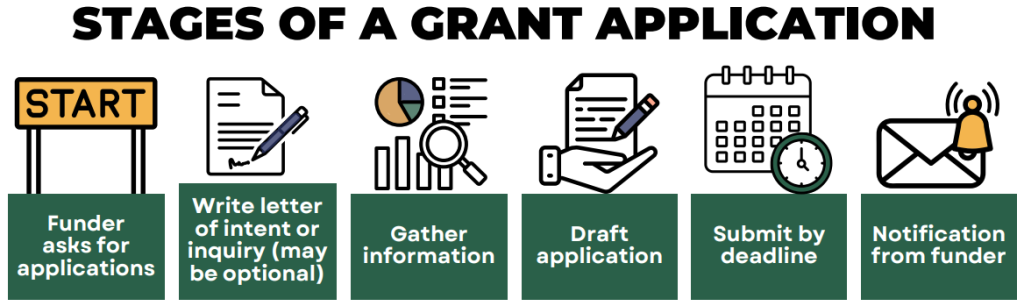
Stages of A Grant Application
- Funder asks for applications
- Write letter of intent or inquiry (may be optional)
- Gather information
- Draft application
- Submit by deadline
- Notification from funder
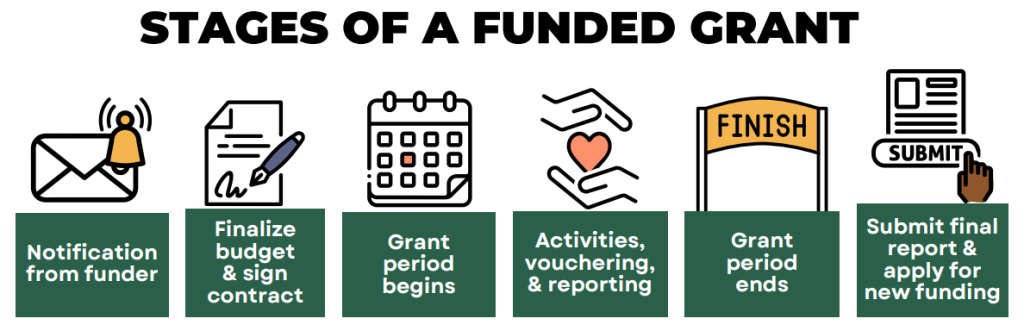
Stages of A Funded Grant
- Notification from funder
- Finalize budget and sign contract
- Grant period begins
- Activities, vouchering and reporting
- Grant period ends
- Submit final report and apply for new funding
Parts of An Application
Every grant application and grant funder is different and may ask for different information as part of the application or proposal for their grant. Read on to learn about some common elements.
Letter of Intent or Inquiry (LOI): A short letter describing your organization and specific funding request that is sent to the funder before a full grant proposal. Some foundations prefer this, and some federal and state grants request or require an LOI.
Cover Letter or Cover Sheet: Sometimes requested as the first page of a grant application. A cover letter introduces the applicant and summarizes the proposal. A cover sheet, also called a face page, must contain specific information requested by the funder, who may provide a specific form.
Application or Proposal: The full, detailed grant request. Funders may request a specific format, such as writing answers to a list of questions they provide, or may allow the applicant to choose any format.
Attachments: Other documents the funder wants included with the application. Attachments may be required or optional. Examples of requested attachments include resumes of key staff, organizational charts and proof of nonprofit status or fiscal sponsorship. Read the funder's instructions carefully.
Budget: The financial plan for each grant period. Includes the estimated cost of everything you need for the project, including staff and materials. Budgets are divided into budget lines, or categories. Many funders will provide a budget form. They may also provide a list of what funds can and cannot be spent on ("allowable" or "not allowable"). Every planned expense should be explained. The funder must approve the budget.
Budget Narrative: A written description of the purpose of each expense, often including an explanation of how the dollar amounts were calculated, for example, listing the price per unit and number needed.
Letters of Support: Written letters from organizations that show their support for your project. Letters of Commitment describe the role they will have in the project. May be required or optional.
Budget Basics
Grant proposals should include a budget breakdown. The funder may ask you to fill out a specific form. Below is a sample of some of the parts of a budget.
Budget Breakdown
- The funder may provide a list of categories similar to A-H on the table below. They may also say that some budget categories are "not allowable" for a certain grant.
- For amount requested, enter an amount for each budget line (category), even if the amount is $0.
- For indirect costs (H), calculate 10% of the total the budget items (A-G).
- The total of all budget lines should be equal to or less than the maximum grant award.
| Budget Items | Amount Requested |
|---|---|
| A. Salaries | $51,500 |
| B. Fringe Benefits | $22,600 |
| C. Travel | $655 |
| D. Supplies | $4,100 |
| E. Equipment | $0 |
| F. Professional Services | $4,500 |
| G. Other | $6,000 |
| H. Indirect Costs (Maximum: Total of Lines A-G x 10%) | $8,935.50 |
| Total | $98,290.50 |
Budget Narrative or Justification
Many funders will request a budget narrative or justification to provide more detail on how each budget line is spent and why.
- Include a description for each item or service you plan to pay for using the grant funding
- Include math to show how you calculated each amount.
- Make sure the total for each line adds up and matches your overall budget
- Include a line for each item or service you hope to pay for using this grant funding. Make sure each expense you list is allowable according to the funder.
They may provide a format, but here are two examples of how narrative justifications can be written.
Example 1
A. Salaries: Provide position titles, role description, employee names (if known), annual salary rate, and percentage of the position's time and effort to be spent on the grant.
| Position | Name | Annual Salary | % Effort | Cost |
|---|---|---|---|---|
| (1) Director | Jane Smith | $65,000 | 10% | $6,500 |
| (2) Program Coordinator | To be Selected | $45,000 | 100% | $45,000 |
| Total Salaries: $51,500 |
- The Director will provide supervision and oversight of programs and staff for this grant.
- The Program Coordinator will coordinate all programs, services, and activities for this grant including planning, implementation and reporting.
Example 2
E. Professional Services: $4,500
- Printing costs ($0.10/copy x 5,000 copies) = $500
- Healthy meals for group participants ($20/person x 200 participants)= $2,000.
Grant Resources
Get Free Grant Help
The Office of Health Equity provides free grant technical assistance for organizations and groups serving minority, marginalized, and underserved communities in Erie County. We can help with:
- Finding grants
- Applying for grants
- Data & Evaluation
- Grant reporting
Find Grant Funding
Search for grants, set up email alerts and find more resources by visiting the following websites.
- Federal funding opportunities (Grants.gov)
- New York State funding opportunities
- Candid.org has a foundation directory can be accessed for free at the Central Library branch in downtown Buffalo.
Erie County Library Grant Writing Resources
Databases, websites, local links and library materials to support your grant writing journey. If you visit the library, you can ask any librarian for help using these resources.
Census Data Assistance
Find and learn how to use U.S. Census data in your grant applications by contacting our local Census representative.
Email amy.a.brombos@census.gov
Call 202-573-3978